Showing posts with label horses. Show all posts
Showing posts with label horses. Show all posts
27.1.09
Audio-visual equestrian puns
Anybody else notice that Anky and Saliniero are piaffing to Piaf?
(For those not in the dressage know, the piaffe is where the horse trots in place. And Edith Piaf? Well she's French! The song used at the beginning and the end of this kur is "Je ne regrette rien.")
P.S. This video is from the 2006 World Equestrian Games. We can't wait until the 2010 World Equestrian Games come to Lexington! Whee!

28.6.08

26.6.08
Bubba the Round

"Is it OK to work a horse when it's pregnant?"
"Well, up to a point, but HE's not pregnant."
"When's she due?"
"HE's not. HE is just really, really fat."
Bubba barely fits in the shafts. He's one half of the hypothetical good ol' boy team of Bubba and Jimbo. Bubba and Jim are about the same height. But they are NOT the same width.
3.4.08
Gentrification, then... Aristocratization?
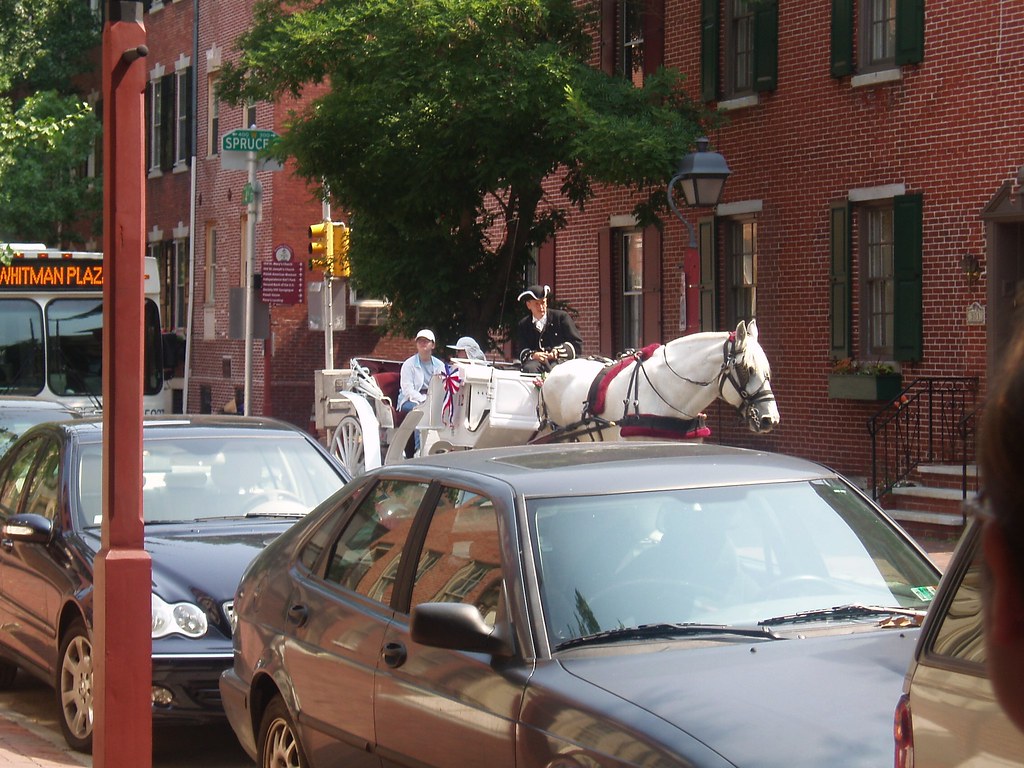
Our carriage company sits in an increasingly-dense forest of half-million dollar townhouses and condominiums. They're springing up like dandelions this spring. Already, we've been in a battle with the construction guys across the street over where they park their backhoe (Answer: NOT in my boss's parking space next to the yard the horses use for R&R).
Daily movements to and from work are a maze of blocked streets, cement mixers, backhoes, and a particularly aggressive construction-cantina-on-wheels driver. Getting hay in and manure out is a headache.
So, it was with great amusement that I read this article in that great fake news source, The Onion:
Report: Nation's Gentrified Neighborhoods Threatened By Aristocratization
WASHINGTON—According to a report released Tuesday by the Brookings Institution, a Washington-based think tank, the recent influx of exceedingly affluent powder-wigged aristocrats into the nation's gentrified urban areas is pushing out young white professionals, some of whom have lived in these neighborhoods for as many as seven years.
[...]
"A three-block section of [Chicago neighborhood] Wicker Park that once accommodated eight families, two vintage clothing stores, a French cleaners, and a gourmet bakery has been completely razed to make way for a private livery stable and carriage house," Kennedy said. "The space is now entirely unusable for affordable upper-income condominium housing. No one can live there except for the odd stable boy or footman who gets permission to sleep in the hayloft."
Be sure and read the whole article.
Maybe aristocratization would help the horse and carriage business, after all.
This has been your bit of random sillyness for the day, brought to you by thedrafthorse.com.
The photo of Scott and Rex on Fourth Street is brought to you by b a r t on flickr.com.
9.3.08
Happy 33rd, John Henry
When Louis XIV died in 1715, most of the people he ruled over had known no other sovereign. He had been King of France for 72 years. His great-grandson inherited his throne and the magnificent palace the Sun King had built at Versailles.

When the great John Henry retired from racing at the age of 9, he'd acquired 39 wins, 15 places and 9 shows in 83 starts, with an earnings total of over $6.5 million. He was (and is) the oldest horse to win Horse of the Year--and assuredly it must have felt like John had been racing forever and would always be back for another campaign. Those who raced against him may well have had offspring who were racing when John still covered the turf with that mighty 18 ft. stride.
Then, John retired to the Horse Park in 1985. TheKentucky Horse Park had only opened in 1978, and was still struggling to find its identity. John Henry quickly became its heart.
I first went to the Horse Park when we moved to Lexington in 1986. It was a strange thing to go to the park in January of 2008 without being able to see the ol' Steel Drivin' Man. Just as there were those who had never knew a king other than Louis XIV, there were those of us who had never known a Hall of Champions without John Henry. It seemed like he would live forever. But John passed peacefully on October 8, 2007.
The Kentucky Horse Park will welcome the world's equestrian royalty when it hosts the FEI World Equestrian Games in September 2010. This will be the first time the games have been held outsides of Europe. The World Equestrian Games will be the largest equine event ever held in North America, and the largest sporting event ever held in the state of Kentucky.
Louis XIV converted a hunting lodge into Versailles.
The Kentucky Horse Park, the finest equestrian venue in the world and the only park exclusively dedicated the the horse, is the house that John built.
Happy Birthday, John Henry. Have a chocolate covered Krispy Kreme in horse heaven on us.
JOHN HENRY (Ol' Bob Bowers - Once Double by Double Jay): March 9, 1975 - October 8, 2007

When the great John Henry retired from racing at the age of 9, he'd acquired 39 wins, 15 places and 9 shows in 83 starts, with an earnings total of over $6.5 million. He was (and is) the oldest horse to win Horse of the Year--and assuredly it must have felt like John had been racing forever and would always be back for another campaign. Those who raced against him may well have had offspring who were racing when John still covered the turf with that mighty 18 ft. stride.
Then, John retired to the Horse Park in 1985. The
I first went to the Horse Park when we moved to Lexington in 1986. It was a strange thing to go to the park in January of 2008 without being able to see the ol' Steel Drivin' Man. Just as there were those who had never knew a king other than Louis XIV, there were those of us who had never known a Hall of Champions without John Henry. It seemed like he would live forever. But John passed peacefully on October 8, 2007.
The Kentucky Horse Park will welcome the world's equestrian royalty when it hosts the FEI World Equestrian Games in September 2010. This will be the first time the games have been held outsides of Europe. The World Equestrian Games will be the largest equine event ever held in North America, and the largest sporting event ever held in the state of Kentucky.
Louis XIV converted a hunting lodge into Versailles.
The Kentucky Horse Park, the finest equestrian venue in the world and the only park exclusively dedicated the the horse, is the house that John built.
Happy Birthday, John Henry. Have a chocolate covered Krispy Kreme in horse heaven on us.
JOHN HENRY (Ol' Bob Bowers - Once Double by Double Jay): March 9, 1975 - October 8, 2007
21.2.08
Come walk with me, fellow traveler

Pete and Christina in the yard, August 2007
Henry Beston writes:
We need another and a wiser and perhaps a more mythical concept of animals... We patronize them for their incompleteness, for their tragic fate of having taken form so far below ourselves. And therein we err, and greatly err. For the animal shall not be measured by man. In a world older and more complete than ours they moved finished and complete, gifted with the extensions of the senses we have lost or never attained, living by voices we shall never hear. They are not brethren, they are not underlings; they are other nations caught with ourselves in the net of life and time, fellow prisoners of the splendor and travail of the earth.
4.2.08
An update, on many fronts...
It's been a while since I last updated my blog or my website (before Christmas! Egad!). In the interim, we were very busy at work with the holiday, then Peter and I headed home to Kentucky for a couple of weeks of R & R (and visiting our other equine friends at the Horsiest Place on Earth). Then, my laptop's hard-drive became terminally ill. So... Now I'm back (I still have to reload Dreamweaver on my computer...The hard-drive transplant wiped ALL of my programs and saved only my data).
Several months ago, I wrote about a fantastic blog by Jean-Leo Dugast, percheron-international.blogspot.com. More recently, I linked to an article about the use of urban horses in France. Percheron-International has a new post about Lasso-du-Jardin, a Breton cob gelding who collects recycling in Trouville-sur-Mer. You really must go to Percheron-International to see Jean-Leo's marvelous photos of Lasso in action.
For those who don't read French, here's a translation of the text from Percheron-International.
This title of "accrocheur" does not refer to Lasso-du-Jardin's age. At only nine years old and with two years of professional experience, one could say that Lasso is nothing but a neophyte.
If he "takes up the bottle," it is those bottles of the restaurants and cafes from the city of Trouville-sur-Mer in the Calvados. Seven years ago, the municipality put into place an empty-bottle collection service - Wednesdays for local residents and Mondays, Tuesdays, Thursdays, and Fridays for commercial establishments.
Lasso-du-Jardin is gradually replacing Festival-de-Mai (May Day), a 15-year-old Percheron gelding who inaugurated the service. Three people, Christelle, Pascal and Sebastien, supervise the four-legged municipal employees, and take turns on the recycling routes.
Trouville, like nearby Saint-Pierre-sur-Dives, is one of the cities spearheading the effort to use draft horses in an urban setting. Today, there are 70 cities in France that use horses for maintaining green spaces, collecting garbage and providing surveillance. This number is growing rapidly.
After only having year after year of hopes without concrete realization, the urban horse is finally taking off. Urban drafts, forestry drafts, agricultural drafts--draft horses give us a message of hope: hope of a world where one can "work differently to live better."
Jean-Leo Dugast, percheron-international.blogspot.com
Several months ago, I wrote about a fantastic blog by Jean-Leo Dugast, percheron-international.blogspot.com. More recently, I linked to an article about the use of urban horses in France. Percheron-International has a new post about Lasso-du-Jardin, a Breton cob gelding who collects recycling in Trouville-sur-Mer. You really must go to Percheron-International to see Jean-Leo's marvelous photos of Lasso in action.
For those who don't read French, here's a translation of the text from Percheron-International.
This title of "accrocheur" does not refer to Lasso-du-Jardin's age. At only nine years old and with two years of professional experience, one could say that Lasso is nothing but a neophyte.
If he "takes up the bottle," it is those bottles of the restaurants and cafes from the city of Trouville-sur-Mer in the Calvados. Seven years ago, the municipality put into place an empty-bottle collection service - Wednesdays for local residents and Mondays, Tuesdays, Thursdays, and Fridays for commercial establishments.
Lasso-du-Jardin is gradually replacing Festival-de-Mai (May Day), a 15-year-old Percheron gelding who inaugurated the service. Three people, Christelle, Pascal and Sebastien, supervise the four-legged municipal employees, and take turns on the recycling routes.
Trouville, like nearby Saint-Pierre-sur-Dives, is one of the cities spearheading the effort to use draft horses in an urban setting. Today, there are 70 cities in France that use horses for maintaining green spaces, collecting garbage and providing surveillance. This number is growing rapidly.
After only having year after year of hopes without concrete realization, the urban horse is finally taking off. Urban drafts, forestry drafts, agricultural drafts--draft horses give us a message of hope: hope of a world where one can "work differently to live better."
Jean-Leo Dugast, percheron-international.blogspot.com
If only they could have taken the horse to the PMA steps...
This was by far the best Super Bowl commercial:
I didn't get to see the game because I was at the barn here in Philly taking care of a sick horse (appropriately named Bud). Bud's got a work ethic like few other horses, and I hope the good folks out at New Bolton can figure out what's wrong with the grand old man.
I didn't get to see the game because I was at the barn here in Philly taking care of a sick horse (appropriately named Bud). Bud's got a work ethic like few other horses, and I hope the good folks out at New Bolton can figure out what's wrong with the grand old man.
17.12.07
4-hoof drive is better than 4-wheel drive
One of the many wonderful things on YouTube (from poster ccalhoun1):
Brings literal meaning to the question (oft heard on SportsCenter, or refering to automobiles) "Do they have the horses?"
Brings literal meaning to the question (oft heard on SportsCenter, or refering to automobiles) "Do they have the horses?"
11.12.07
France seeks to use more horses for transportation.
This can only be described as AWESOME.
Bring back the horse; go green; save the Earth.
As I tell small children who hold their noses and make faces walking past me and Chip in Philadelphia:
Horses smell better than diesel.
"It's great for workers and the community to have contact with a living thing," Linot said.
"The civil servants are on strike now, but I tell you if they had their hands on a horse they'd be happier – I've never seen a driver kiss his truck."
Bring back the horse; go green; save the Earth.
As I tell small children who hold their noses and make faces walking past me and Chip in Philadelphia:
Horses smell better than diesel.
19.11.07
Continuing to fight against the march of "progress"
From today's Herald Leader, an article on the difficulties facing the draft horse industry.
9.10.07
Racehorse names
C'mon, now, Jockey Club!
How come you can't name a horse Nutzapper or Sally Hemmings, but you can name her Panty Raid?
Inquiring draft horses want to know.
How come you can't name a horse Nutzapper or Sally Hemmings, but you can name her Panty Raid?
Inquiring draft horses want to know.
28.9.07

31.8.07
Horse Theme Songs...
Chip, my lastest regular horse, has a theme song now. This is a good thing, adding to a long history of theme songs for horses I drive. That's when I know I've gotten really attached.
Chip-a-dee-doo-dah, Chip-a-dee-ay!
One cute horsie is a-walkin' your way.
When he sees other horses
He lets out a neigh.
Chip-a-dee-doo-dah, Chip-a-dee-ay!
Mister Nick-Nick on the corner,
It's the truth--Chip loves you!
And he wants to come nuzzle you...
Chip-a-dee-doo-dah, Chip-a-dee-ay!
Wonderful horsie, wonderful day!
Chip-a-dee-doo-dah, Chip-a-dee-ay!
One cute horsie is a-walkin' your way.
When he sees other horses
He lets out a neigh.
Chip-a-dee-doo-dah, Chip-a-dee-ay!
Mister Nick-Nick on the corner,
It's the truth--Chip loves you!
And he wants to come nuzzle you...
Chip-a-dee-doo-dah, Chip-a-dee-ay!
Wonderful horsie, wonderful day!
24.8.07
Ride 'em, Cowboy!
I have always heard about the black cowboys in Philadelphia, but had never actually seen them...
I've heard stories about taking our horses out on the breaking cart into north Philly and surprising an unsuspecting normal sized horse tied to someone's front stoop, once in a blue moon--so I always figured if I saw some of Philly's urban horses, it would be in north Philly or in west Philly.
But today, I was coming down 19th towards Spring Garden when a dainty black pinto in Western wear clip-clopped from Spring Garden onto 19th and down towards Callowhill.
Cool.
Yay, urban horses!
This reminds me... One of my favorite things about interacting with the general public on the street (you know, the people who don't want to take a ride, but just want to pet my horse) is getting to talk to and educate people who have literally never ever seen a real live horse, let alone get close to one. Chip (or Pete or Trump or whoever) may be the ONLY horse they will ever encounter, and I get to facilitate that.
Also cool.
I've heard stories about taking our horses out on the breaking cart into north Philly and surprising an unsuspecting normal sized horse tied to someone's front stoop, once in a blue moon--so I always figured if I saw some of Philly's urban horses, it would be in north Philly or in west Philly.
But today, I was coming down 19th towards Spring Garden when a dainty black pinto in Western wear clip-clopped from Spring Garden onto 19th and down towards Callowhill.
Cool.
Yay, urban horses!
This reminds me... One of my favorite things about interacting with the general public on the street (you know, the people who don't want to take a ride, but just want to pet my horse) is getting to talk to and educate people who have literally never ever seen a real live horse, let alone get close to one. Chip (or Pete or Trump or whoever) may be the ONLY horse they will ever encounter, and I get to facilitate that.
Also cool.
30.7.07

16.7.07
Well, I finally did it...
There's one of these stupid threads about the "poor carriage horses" on phillyblog.com, and instead of ignoring it, I responded. With a manifesto. Which I doubt anyone will actually read, except to make fun of me, but I had to get it out. I'm sorry, but the notion that we would EVER send our horses to slaughter is so ridiculous, I couldn't let it go.
You can read the posts leading up to my tirade, here:
http://www.phillyblog.com/philly/showthread.php?t=40172
Here's my post, in its entirety:
bloosum et al:
Do ANY of you have ANY proof to back up your dangerously slanderous statements about "cruel heartless carriage company owners" and "carriage horses going to slaughterhouses"? Does anyone here actually KNOW anyone in the carriage business? (Well you know someone now… now that I’m on this thread… haha)
I am sick and tired of people who have never actually talked to anyone who works with horses for a living going around telling everyone that "carriage horses are all abused," that it's "torture" for a horse to be in harness, and that people who make their living working with horses and operating a carriage business are "cruel" and "heartless," and are only interested in $$$.
I work for 76 Carriage Company, and I will tell you that we carriage drivers love and care for our horses, just as much as you care for your pets. That being said, our horses are NOT "pets": They are much, much, MUCH more than that... they are our co-workers, our partners, our students, our teachers, our livelihoods, and, most importantly, our friends. I spend nearly as much time with my Percheron/Morgan cross, Pete, as I do with my husband. The idea that we would EVER EVER repay the gifts and rewards our horses have given us through years of service and partnership with a one-way trip to a slaughterhouse is so incredibly repugnant that I can hardly type.
76 Carriage horses are not sent to slaughter. Period. They are not used to feed Europeans, dogs or zoo lions.
While I cannot speak to the specifics of the goings-on at other companies and can only speak for myself as an individual carriage driver, I can say that the idea that the carriage drivers working in this city DO NOT CARE about their horses and harm them for fun or profit is an OFFENSIVE, ERRONEOUS GENERALIZATION and a disservice to the commitment we make to our equine partners.
When 76 Carriage horses are ready to retire due to age, physical infirmity, or just because they just don't want to work in the city anymore, we find them good homes where we know that they will be well cared for. Three of our horses, Theo (aged 25), Scooby (23), and Commanche (20), were all retired in January 2006, after more than 15 years each of service to our company. They had to be retired together, because they’d been friends for most of their lives. They now live happily in New York, on a 155-acre farm, Three Amigos still. (There was an article to this effect in the Inquirer a year and a half ago, if you don’t believe me.) Another of our horses, Prince, was retired 4 or 5 years ago. He now putters around our barn and in the yard on Bodine Street, hanging out under the trees, mugging me for treats, hating to get bathed, grooming his horse friends, and receiving carrots from his many admirers in Northern Liberties. Another horse, Lancelot, recently told us that although he was perfectly fit, sound and healthy for riding and driving, he was through with SEPTA buses, Jersey drivers, and Duck boats, so he’s made a midlife career change to a farm (also in New York), where he does some light country driving and work under saddle.
Our horses are NOT sent to auction, where they could potentially be bought by "kill buyers" and they are NOT sent to the slaughterhouse. As a matter of fact, many of our horses, at some stage in their life history have passed through mixed sales, such as the infamous New Holland auction, where they could have been purchased by killer buyers, but fortunately ended up purchased by our company, private individuals, or one of the horse dealers we do business with.
When a horse has worked for us, they have earned the right to be certain that they will always have a good home, either with us, doing nothing but eating and having company money spent on them, or with a new family that can take care of them with the same sort of love and care they had here in Philadelphia.
Oh, I can hear the End-the-slavery!-Free-the-horses!-crowd now…”But there is no love and care for carriage horses. Carriage horses are machines used until they get broken and are thrown away. Carriage rides are abuse!” I will not deny that SOME carriage companies in SOME places at SOME times have, unfortunately and tragically, not held up their end of the deal in the human-equine partnership. But to make blanket unfounded statements about the nature of the industry without a shred of hard evidence-- in fact, with much evidence to the contrary-- is the same as saying “Some people abuse their children. Therefore, NO ONE should be a parent. In the 19th century, there were no child labor laws and infant mortality was high. Therefore, today, we should view child-rearing as a outdated relic of a bygone era and it should be eradicated by forward-thinking people.”
So, what love and care do our horses receive?
*Stalls cleaned twice a day.
*Fresh, quality wood shavings added daily.
*Pretty much all the hay anyone can eat (unless some of our more, um, portly friends are needing to trim down—if anything, our horses are pleasantly plump).
*An individualized grain feeding two or three times a day.
*Continuous access to fresh water in their stalls and yards and main barn.
*Custom shoes made and fitted by a qualified farrier.
*Pedicures no less often than every 5-6 weeks.
*Housecalls by a veterinarian who regularly sees our horses and gives them annual physicals.
*In emergencies, horsevan rides to New Bolton Center, where our horses have (thankfully infrequently) been treated by the same doctors that worked on the late, great Barbaro.
*Free time to run around, act silly, eat and roll in one of our three yards.
*Turn out time in Lancaster County several months a year.
*Well-cared for and properly fitted harness.
*Work schedules individually tailored to each horse’s physiology and divergent exercise needs.
*Regular grooming, bathing and haircuts.
*Cold showers on hot days.
*Warm blankets and a cozy barn on frigid nights.
That’s just the physical needs our horses have tended to (and is far from comprehensive—it cannot possibly account for all the little things done for them).
Our horses are tended to mentally and emotionally, too:
*They are given patient and proper training to learn how to do the things they are asked to do.
*They are paired with regular drivers who know, understand and truly appreciate all their individual idiosyncracies (Jim is fascinated by dogs and kids, Noodle hates hoses, Bud loves bananas, Turk loves his hind feet scratched, Nick is paranoid about having his hind feet touched, Tom has learned from Teddy how to open stall doors, Merlin and Teddy and Prince are BestFriendsForever, etc. etc. etc.).
*They are given meaningful, varied, and not-terribly-physically-difficult work to do. (And before anyone starts yelling about stabled draft horses not needing work to do, might I point you to what happens to a border collie who’s not given sheep to herd and is cooped up in someone’s suburban kitchen all day.)
*They are given contact with other horses and find their place within a whole social hierarchy full of friendships, rivalries, mutual grooming sessions, and whinnied, snorting conversations that we humans will never understand. Their daily routine actually more closely mimics the spatial routine of wild horses than many other equine management scenarios.
Plus, our 20 horses get the love and affection (and treats—carrots galore!) of the following: a couple dozen full- and part-time carriage drivers; our barn manager and a half-dozen stable hands who are on the job from 6:30 in the morning until 11:00 at night, seven days a week, 365 days a year; former carriage drivers who work with the Big Buses and Trolleys and who keep an eye out for us on the streets; office staff and managers; and the big boss man himself, The Carriage Company Owner, who—like the French and Belgian farmers who developed the majestic draft breeds we use today—lives under the same roof as his horses.
Our carriage horses are a family—they’re a herd, surrounded by a network of human herd-members.
Beyond the constant, daily attention of their people, our horses are public horses. They are equine ambassadors. They appear in movies, on TV, and in books. Many of the tourists they meet on the street have never been so close to a horse in their lives. Since they are public horses, they are in the view of the (sometimes ill-informed) general public, the City of Philadelphia, and Animal Control, all also looking after their well-being. On a broader note, 76 Carriage Company (see www.phillytour.com, FAQs) is a proud member of the Carriage Operators of North America (see www.cona.org), and is part of the larger family of the Animal Welfare Council and American Horse Council.
Because they are so well-cared for, our horses frequently live into their 30s (average full lifespan of a horse is 25-30 years old—but many horses are not so fortunate as ours are), after having spent most of their lives as “carriage horses.”
At work, these horses have virtually every bladder and bowel movement noticed, their water and food intake monitored, their respiration and perspiration observed, all in the interest in maintaining a high-quality of life (both at work and at play) for them for many, many years to come. Rest assured that it is not in ANYONE’s best interest for our horses to be over-stressed from heat or from work—or from lack of it.
I urge you to truly educate yourselves about what you claim to know so much about… when in fact, you know so little. One of the unspoken, unappreciated losses resulting from the rise of the automobile in the first part of the 20th century has been the loss of humanity’s connection to the horse. What was once an everyday experience has become a tourist attraction. (It’s too bad, because I’d rather hug my horse than my Toyota, and horses smell better than diesel fumes.) To quote an art instructor at the Pennsylvania Academy of Fine Arts where one of our horses models, “Civilization as we know it rests in the gap in a horse’s teeth.”
(Remark heard downtown: “Horses need to live in the country, on a farm. I can’t believe those horses can live in the city. How can these horses possibly live here in Philadelphia?”
Response: “The same way they’ve been living here since 1682.”)
I’m one of the lucky people who gets to experience, every single day I go to work, one of the great mysteries and beauties of our humanity: how it is that we can connect with another species, so absolutely alien to us, and learn from each other how to work together. Our history is commingled with the horse’s. It’s a minor miracle of the partnership between man and the domestic horse every morning when my horse chooses to do what I ask him to do. (He weighs 1600 lbs. I can’t make him, even if I wanted to.) And I’ve learned how to listen to my horse. It’s a special thing to groom a horse (as I did this morning) and he decides to groom you back.
Unfortunately, most people never get to experience that partnership. The closest they get is a brief glimpse walking down the sidewalk in front of the Liberty Bell. All that special knowledge, all that understanding that’s been established from centuries of cohabitation between horse and human, has been lost for most people, people who think that they “know” horses, because they read Black Beauty and played with My Little Ponies.
Yet I can’t tell you how many people have pointed at my horse, taking a nice nap in the carriage stand between rides, his hind leg cocked because he’s relaxed, and exclaimed, “Oh, look, his leg is hurt!” only to have Pete shift his weight from one hind foot to the the other. Oh, look. Now his other leg is “hurt.” Other people ask all the time about the chestnuts (dew claws) on the inside of EVERY horse’s legs, making accusations about the “scabs” or “sores” there. News for you: all horses have them; they’re vestigial thumbnails.
The same ignorance about basic equine physiology and behavior is demonstrated every time someone tells me that my horse is about to drop dead of heat exhaustion “because he’s sweating.” Of course he’s sweating! It’s summertime! I’m sweating, too. Thankfully, horses, like humans, have sweat to operate as an efficient cooling system (modern horses, like humans, originally evolved on the grassy, hot savannahs and plains). It’s really when a horse is blowing (panting/breathing hard), and can’t cool himself down through sweating, or when a horse is dehydrated, that is cause for concern. Horses are like people: some people handle the heat better than others (fit people better than fat people, young adults better than the very old or very young). The key is taking precautions (proper hydration, staying in the shade when possible, not overexerting oneself, building up physical cardiovascular fitness, respecting one’s individual limitations) and knowing the horse in question (which is a lot easier to do when one spends 40-50 hours a week with that horse, rather than 10 seconds driving past on 5th Street shouting PETA pablum out an SUV window).
Don’t hesitate to actually TALK to us carriage people. (We are individual people working for individual companies, just as our horses are individual horses, after all—blanket generalizations are not at all useful). I, for one, am happy to continue this discussion with anybody, so long as it is a DISCUSSION, not the previous slander based on the continued blind spouting of misinformation and politically charged rhetoric.
Ask questions. A nice one to start with is, “May I pet your horse?” or “What’s his name?”
Just please don’t ask me, “DOES your horse have a name?” (I actually get this a lot. In a holier-than-thou, accusatory tone, at that. My response: Does your cat have a name? Does your child?)
Of course he does.
My horse’s name is Pete. And yes, he knows it.
And the other horses have names, too. The horses of 76 Carriage Company (Bud, Teddy, Bill, Trump, Noodle, Turk, Jim, Bubba, Tom, Rex, Carter, Merlin, Spot, Buzz, Chip, BB, Nick, Ben, Pete, Mike, and Prince), Philadelphia Carriage Company (Obie, Omar, Dominic, Da Vinci, Napoleon, Murphy, Caesar, Vernon, Cartman, Louie, Little John, Madison, Hershey, Smoky, Mickey, and Blue), and Olde City Carriage (Willy, Woody, Suzie, Moe and Truman) appreciate that y’all love them (for how could you not love the horses?), and hope you’ll be better informed about them in the future.
You can read the posts leading up to my tirade, here:
http://www.phillyblog.com/philly/showthread.php?t=40172
Here's my post, in its entirety:
bloosum et al:
Do ANY of you have ANY proof to back up your dangerously slanderous statements about "cruel heartless carriage company owners" and "carriage horses going to slaughterhouses"? Does anyone here actually KNOW anyone in the carriage business? (Well you know someone now… now that I’m on this thread… haha)
I am sick and tired of people who have never actually talked to anyone who works with horses for a living going around telling everyone that "carriage horses are all abused," that it's "torture" for a horse to be in harness, and that people who make their living working with horses and operating a carriage business are "cruel" and "heartless," and are only interested in $$$.
I work for 76 Carriage Company, and I will tell you that we carriage drivers love and care for our horses, just as much as you care for your pets. That being said, our horses are NOT "pets": They are much, much, MUCH more than that... they are our co-workers, our partners, our students, our teachers, our livelihoods, and, most importantly, our friends. I spend nearly as much time with my Percheron/Morgan cross, Pete, as I do with my husband. The idea that we would EVER EVER repay the gifts and rewards our horses have given us through years of service and partnership with a one-way trip to a slaughterhouse is so incredibly repugnant that I can hardly type.
76 Carriage horses are not sent to slaughter. Period. They are not used to feed Europeans, dogs or zoo lions.
While I cannot speak to the specifics of the goings-on at other companies and can only speak for myself as an individual carriage driver, I can say that the idea that the carriage drivers working in this city DO NOT CARE about their horses and harm them for fun or profit is an OFFENSIVE, ERRONEOUS GENERALIZATION and a disservice to the commitment we make to our equine partners.
When 76 Carriage horses are ready to retire due to age, physical infirmity, or just because they just don't want to work in the city anymore, we find them good homes where we know that they will be well cared for. Three of our horses, Theo (aged 25), Scooby (23), and Commanche (20), were all retired in January 2006, after more than 15 years each of service to our company. They had to be retired together, because they’d been friends for most of their lives. They now live happily in New York, on a 155-acre farm, Three Amigos still. (There was an article to this effect in the Inquirer a year and a half ago, if you don’t believe me.) Another of our horses, Prince, was retired 4 or 5 years ago. He now putters around our barn and in the yard on Bodine Street, hanging out under the trees, mugging me for treats, hating to get bathed, grooming his horse friends, and receiving carrots from his many admirers in Northern Liberties. Another horse, Lancelot, recently told us that although he was perfectly fit, sound and healthy for riding and driving, he was through with SEPTA buses, Jersey drivers, and Duck boats, so he’s made a midlife career change to a farm (also in New York), where he does some light country driving and work under saddle.
Our horses are NOT sent to auction, where they could potentially be bought by "kill buyers" and they are NOT sent to the slaughterhouse. As a matter of fact, many of our horses, at some stage in their life history have passed through mixed sales, such as the infamous New Holland auction, where they could have been purchased by killer buyers, but fortunately ended up purchased by our company, private individuals, or one of the horse dealers we do business with.
When a horse has worked for us, they have earned the right to be certain that they will always have a good home, either with us, doing nothing but eating and having company money spent on them, or with a new family that can take care of them with the same sort of love and care they had here in Philadelphia.
Oh, I can hear the End-the-slavery!-Free-the-horses!-crowd now…”But there is no love and care for carriage horses. Carriage horses are machines used until they get broken and are thrown away. Carriage rides are abuse!” I will not deny that SOME carriage companies in SOME places at SOME times have, unfortunately and tragically, not held up their end of the deal in the human-equine partnership. But to make blanket unfounded statements about the nature of the industry without a shred of hard evidence-- in fact, with much evidence to the contrary-- is the same as saying “Some people abuse their children. Therefore, NO ONE should be a parent. In the 19th century, there were no child labor laws and infant mortality was high. Therefore, today, we should view child-rearing as a outdated relic of a bygone era and it should be eradicated by forward-thinking people.”
So, what love and care do our horses receive?
*Stalls cleaned twice a day.
*Fresh, quality wood shavings added daily.
*Pretty much all the hay anyone can eat (unless some of our more, um, portly friends are needing to trim down—if anything, our horses are pleasantly plump).
*An individualized grain feeding two or three times a day.
*Continuous access to fresh water in their stalls and yards and main barn.
*Custom shoes made and fitted by a qualified farrier.
*Pedicures no less often than every 5-6 weeks.
*Housecalls by a veterinarian who regularly sees our horses and gives them annual physicals.
*In emergencies, horsevan rides to New Bolton Center, where our horses have (thankfully infrequently) been treated by the same doctors that worked on the late, great Barbaro.
*Free time to run around, act silly, eat and roll in one of our three yards.
*Turn out time in Lancaster County several months a year.
*Well-cared for and properly fitted harness.
*Work schedules individually tailored to each horse’s physiology and divergent exercise needs.
*Regular grooming, bathing and haircuts.
*Cold showers on hot days.
*Warm blankets and a cozy barn on frigid nights.
That’s just the physical needs our horses have tended to (and is far from comprehensive—it cannot possibly account for all the little things done for them).
Our horses are tended to mentally and emotionally, too:
*They are given patient and proper training to learn how to do the things they are asked to do.
*They are paired with regular drivers who know, understand and truly appreciate all their individual idiosyncracies (Jim is fascinated by dogs and kids, Noodle hates hoses, Bud loves bananas, Turk loves his hind feet scratched, Nick is paranoid about having his hind feet touched, Tom has learned from Teddy how to open stall doors, Merlin and Teddy and Prince are BestFriendsForever, etc. etc. etc.).
*They are given meaningful, varied, and not-terribly-physically-difficult work to do. (And before anyone starts yelling about stabled draft horses not needing work to do, might I point you to what happens to a border collie who’s not given sheep to herd and is cooped up in someone’s suburban kitchen all day.)
*They are given contact with other horses and find their place within a whole social hierarchy full of friendships, rivalries, mutual grooming sessions, and whinnied, snorting conversations that we humans will never understand. Their daily routine actually more closely mimics the spatial routine of wild horses than many other equine management scenarios.
Plus, our 20 horses get the love and affection (and treats—carrots galore!) of the following: a couple dozen full- and part-time carriage drivers; our barn manager and a half-dozen stable hands who are on the job from 6:30 in the morning until 11:00 at night, seven days a week, 365 days a year; former carriage drivers who work with the Big Buses and Trolleys and who keep an eye out for us on the streets; office staff and managers; and the big boss man himself, The Carriage Company Owner, who—like the French and Belgian farmers who developed the majestic draft breeds we use today—lives under the same roof as his horses.
Our carriage horses are a family—they’re a herd, surrounded by a network of human herd-members.
Beyond the constant, daily attention of their people, our horses are public horses. They are equine ambassadors. They appear in movies, on TV, and in books. Many of the tourists they meet on the street have never been so close to a horse in their lives. Since they are public horses, they are in the view of the (sometimes ill-informed) general public, the City of Philadelphia, and Animal Control, all also looking after their well-being. On a broader note, 76 Carriage Company (see www.phillytour.com, FAQs) is a proud member of the Carriage Operators of North America (see www.cona.org), and is part of the larger family of the Animal Welfare Council and American Horse Council.
Because they are so well-cared for, our horses frequently live into their 30s (average full lifespan of a horse is 25-30 years old—but many horses are not so fortunate as ours are), after having spent most of their lives as “carriage horses.”
At work, these horses have virtually every bladder and bowel movement noticed, their water and food intake monitored, their respiration and perspiration observed, all in the interest in maintaining a high-quality of life (both at work and at play) for them for many, many years to come. Rest assured that it is not in ANYONE’s best interest for our horses to be over-stressed from heat or from work—or from lack of it.
I urge you to truly educate yourselves about what you claim to know so much about… when in fact, you know so little. One of the unspoken, unappreciated losses resulting from the rise of the automobile in the first part of the 20th century has been the loss of humanity’s connection to the horse. What was once an everyday experience has become a tourist attraction. (It’s too bad, because I’d rather hug my horse than my Toyota, and horses smell better than diesel fumes.) To quote an art instructor at the Pennsylvania Academy of Fine Arts where one of our horses models, “Civilization as we know it rests in the gap in a horse’s teeth.”
(Remark heard downtown: “Horses need to live in the country, on a farm. I can’t believe those horses can live in the city. How can these horses possibly live here in Philadelphia?”
Response: “The same way they’ve been living here since 1682.”)
I’m one of the lucky people who gets to experience, every single day I go to work, one of the great mysteries and beauties of our humanity: how it is that we can connect with another species, so absolutely alien to us, and learn from each other how to work together. Our history is commingled with the horse’s. It’s a minor miracle of the partnership between man and the domestic horse every morning when my horse chooses to do what I ask him to do. (He weighs 1600 lbs. I can’t make him, even if I wanted to.) And I’ve learned how to listen to my horse. It’s a special thing to groom a horse (as I did this morning) and he decides to groom you back.
Unfortunately, most people never get to experience that partnership. The closest they get is a brief glimpse walking down the sidewalk in front of the Liberty Bell. All that special knowledge, all that understanding that’s been established from centuries of cohabitation between horse and human, has been lost for most people, people who think that they “know” horses, because they read Black Beauty and played with My Little Ponies.
Yet I can’t tell you how many people have pointed at my horse, taking a nice nap in the carriage stand between rides, his hind leg cocked because he’s relaxed, and exclaimed, “Oh, look, his leg is hurt!” only to have Pete shift his weight from one hind foot to the the other. Oh, look. Now his other leg is “hurt.” Other people ask all the time about the chestnuts (dew claws) on the inside of EVERY horse’s legs, making accusations about the “scabs” or “sores” there. News for you: all horses have them; they’re vestigial thumbnails.
The same ignorance about basic equine physiology and behavior is demonstrated every time someone tells me that my horse is about to drop dead of heat exhaustion “because he’s sweating.” Of course he’s sweating! It’s summertime! I’m sweating, too. Thankfully, horses, like humans, have sweat to operate as an efficient cooling system (modern horses, like humans, originally evolved on the grassy, hot savannahs and plains). It’s really when a horse is blowing (panting/breathing hard), and can’t cool himself down through sweating, or when a horse is dehydrated, that is cause for concern. Horses are like people: some people handle the heat better than others (fit people better than fat people, young adults better than the very old or very young). The key is taking precautions (proper hydration, staying in the shade when possible, not overexerting oneself, building up physical cardiovascular fitness, respecting one’s individual limitations) and knowing the horse in question (which is a lot easier to do when one spends 40-50 hours a week with that horse, rather than 10 seconds driving past on 5th Street shouting PETA pablum out an SUV window).
Don’t hesitate to actually TALK to us carriage people. (We are individual people working for individual companies, just as our horses are individual horses, after all—blanket generalizations are not at all useful). I, for one, am happy to continue this discussion with anybody, so long as it is a DISCUSSION, not the previous slander based on the continued blind spouting of misinformation and politically charged rhetoric.
Ask questions. A nice one to start with is, “May I pet your horse?” or “What’s his name?”
Just please don’t ask me, “DOES your horse have a name?” (I actually get this a lot. In a holier-than-thou, accusatory tone, at that. My response: Does your cat have a name? Does your child?)
Of course he does.
My horse’s name is Pete. And yes, he knows it.
And the other horses have names, too. The horses of 76 Carriage Company (Bud, Teddy, Bill, Trump, Noodle, Turk, Jim, Bubba, Tom, Rex, Carter, Merlin, Spot, Buzz, Chip, BB, Nick, Ben, Pete, Mike, and Prince), Philadelphia Carriage Company (Obie, Omar, Dominic, Da Vinci, Napoleon, Murphy, Caesar, Vernon, Cartman, Louie, Little John, Madison, Hershey, Smoky, Mickey, and Blue), and Olde City Carriage (Willy, Woody, Suzie, Moe and Truman) appreciate that y’all love them (for how could you not love the horses?), and hope you’ll be better informed about them in the future.
12.6.07
9.6.07
A Pun from Peter

Which patron saint do horses pray to?
Saint Thomas Equinas.
(Ba dum bum ching!)
Thanks, Peter.
(The pic above is of the barn's very own Thomas, the tallest horse in Philadelphia. Tom is a 19hh Belgian gelding.)
8.6.07
Like a racehorse...
In honor of tomorrow's Belmont Stakes, I found this column on Slate today. Apparently racehorses pee 1.5 to 2 gallons a day. And Clydesdales pee more. (I could have told y'all that, having seen some of the draft horses around the barn down a five gallon bucket of water, and then having sat through not one, but TWO cycles of a traffic light waiting for Bud to finish up.)
Trump's favorite place is in front of Signer Park.
Many of the carriage horses participate in the long history of public urination outside of the Powel House (Samuel Powel and his wife Elizabeth were famous for their parties there...).
Trump's favorite place is in front of Signer Park.
Many of the carriage horses participate in the long history of public urination outside of the Powel House (Samuel Powel and his wife Elizabeth were famous for their parties there...).
Subscribe to:
Posts (Atom)


 Posts
Posts


